Blog
Project Victoria Incident Report
An incident report based on the Project Victoria case from the SOCSIM course.
🕵️ BEC Investigation Report
Platform: SOC Simulation Project — WDLabs
Environment: Microsoft 365 Unified Audit Logs / Microsoft Sentinel
📋 Case Details
| Field | Value |
|---|---|
| WDLabs Case Name | Project Victoria |
| Case Reference | Case 001 |
| Affected Account | [email protected] |
| Incident Date Range | 2026-03-07 — 2026-03-10 |
| Investigation Date | 2026-06-10 |
| Analyst | k3ng |
1. Attack Narrative
Between 7 March 2026 and 10 March 2026, a threat actor compromised WDLabs’ corporate Microsoft cloud environment, resulting in the unauthorised exfiltration of multiple internal documents and the launch of an internal phishing campaign. The initial breach occurred via an internal phishing email sent from [email protected] to [email protected], suggesting that the sender’s account was compromised by the threat actor. This led to the unauthorised access of the [email protected] account from an unusual external IP. The impact of this incident is account compromise and internal data theft. The threat actor managed to exfiltrate multiple internal PDF documents from the company’s SharePoint site. They also leveraged the compromised account of Donald Anderson to gather information about the company to launch targeted phishing campaigns to other staff members of WDLabs.
2. Timeline of Events
| Time (UTC) | Activity | Detail | Technique |
|---|---|---|---|
| 07/03/2026 02:19:50 | Suspicious Email | A suspicious email was sent by [email protected] to [email protected] regarding training. | T1534 - Internal Spearphishing |
| 07/03/2026 02:27:32 | Initial Access | First malicious login by 15.135.61.79 to[email protected]. | T1078.004 - Valid Accounts: Cloud Accounts |
| 07/03/2026 02:49:55 - 10/03/2026 10:15:51 | Email Access | Multiple emails were read by the threat actor, likely to gather information about the victim. | T1114.002 - Email Collection: Remote Email Collection |
| 09/03/2026 07:10:45 | Malicious Inbox Rule | A new inbox rule named . was created to redirect incoming emails from [email protected] to RSS Feeds. | T1564.008 - Hide Artifacts: Email Hiding Rules |
| 09/03/2026 07:21:05 - 10/03/2026 09:44:34 | SharePoint Exfiltration | Multiple PDF files was exfiltrated from the WDLabsOperations SharePoint site. | T1530 - Data from Cloud Storage |
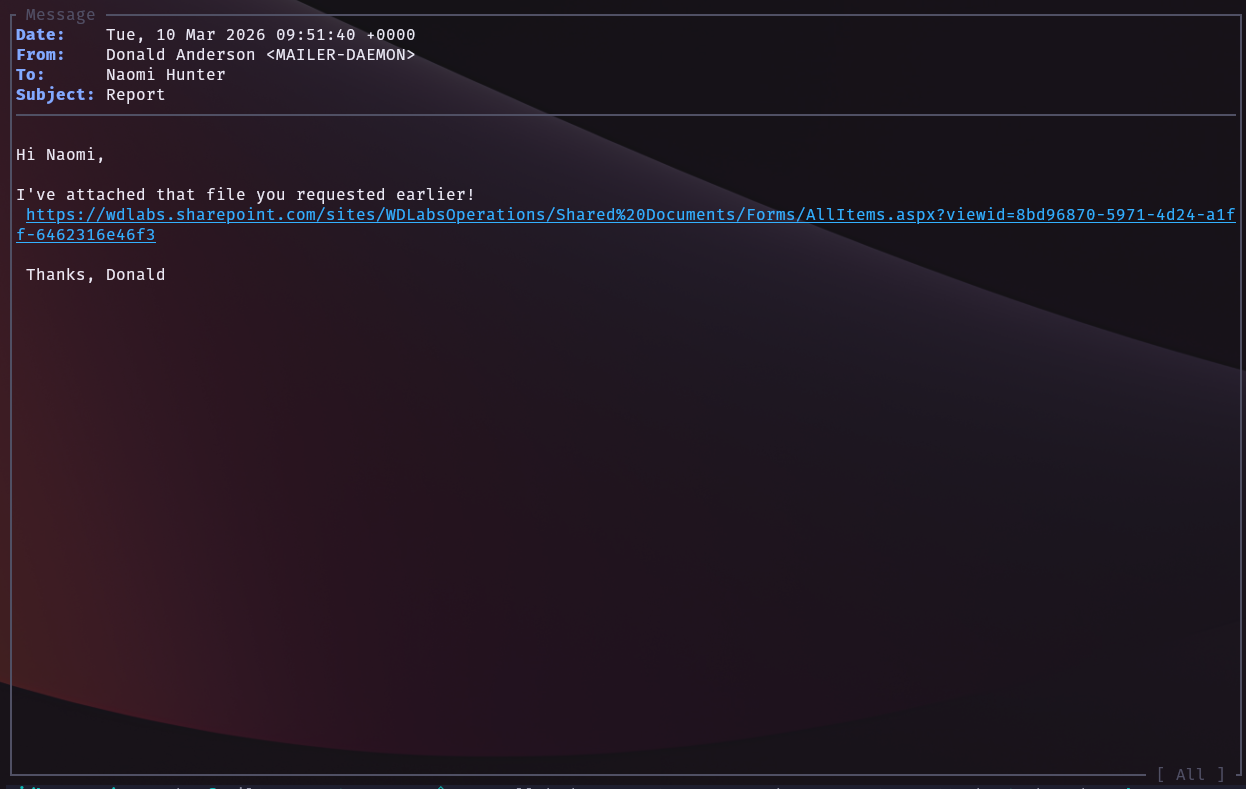
| 10/03/2026 09:51:40 | Suspicious Email | Email sent from [email protected] to [email protected] with the subject Report. | T1534 - Internal Spearphishing |
3. Findings
3.1 Initial Access
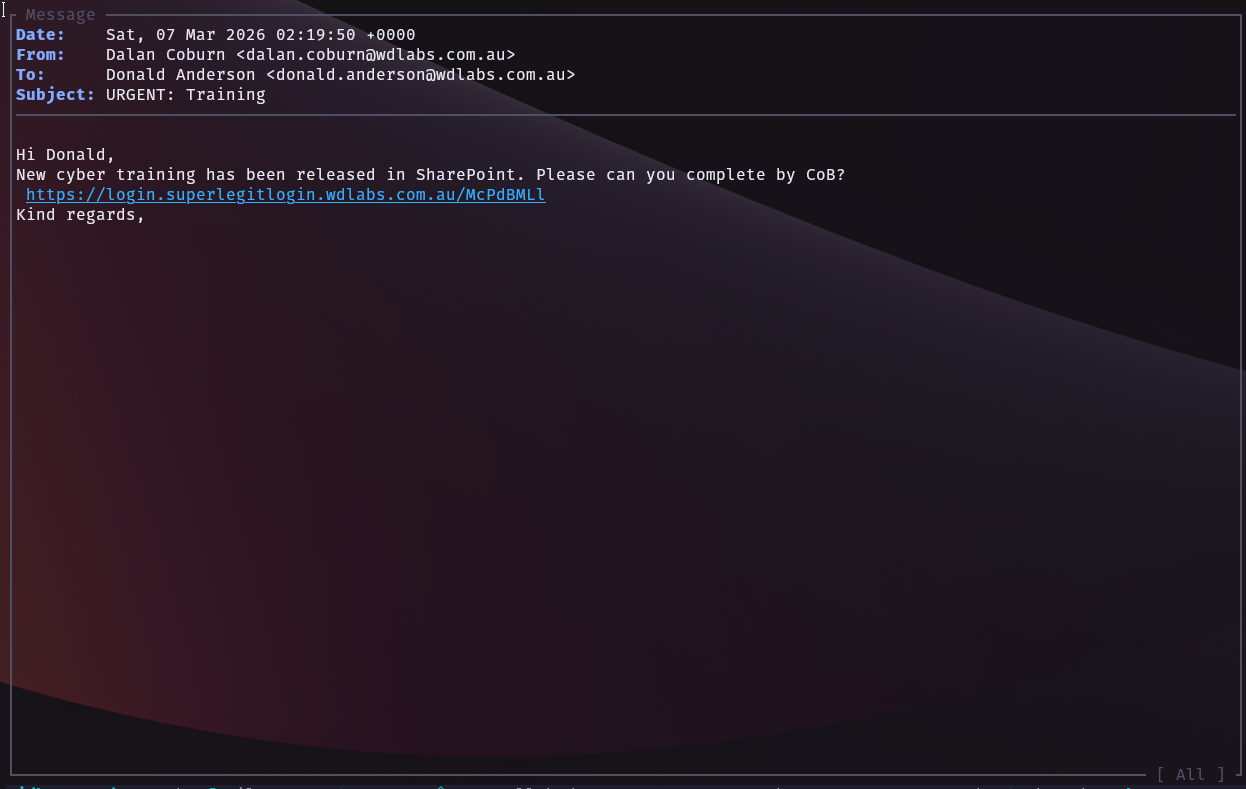
On 7 March 2026 02:19:50 UTC, the [email protected] account sent malicious emails to the target account [email protected]. From our analysis, one email was received by [email protected] and was titled URGENT: Training . The email contains a message requesting the victim to click on a link that supposedly contains a cyber training. The sender also requested the recipient to complete training by close of business (CoB). At the time of investigation, we could not verify the contents of the URL sent by [email protected].
Around 8 minutes after [email protected] received the suspicious email, we recognised a login with the [email protected] account from 15.135.61.79. The geo-location of the IP was identified to be in Sydney, Australia, which did not match the expected baseline of Donald Anderson’s usual activities therefore marking it as a malicious activity. We suspect that the URL sent by [email protected] was a phishing link to harvest the victim’s credentials, allowing the threat actor to log in.
3.2 Unauthorised Activity
On 9 March 2026 07:10:45 UTC, the threat actor created a new inbox rule on the [email protected] account named . from the IP 91.217.249.193:17130. The inbox rule was set up to redirect emails from [email protected] to the RSS Feeds folder. The rule was also set up to always mark captured emails as read. This technique is commonly used to hide any possible security alerts or responses to phishing emails that may be sent to the [email protected] account to a less visible folder.
On 10 March 2026 09:51:40 UTC, the threat actor sent an email from the [email protected] account to [email protected] using the subject Report. The email contains a URL of a file hosted inside the WDLabsOperation SharePoint site. We could not verify the contents of the URL but based on the URL format, it is likely that the URL would return a list of files and folders inside the Shared Documents folder. Due to the privilege of the threat actor, it is possible that the threat actor created a malicious file inside of the trusted SharePoint site to be used as a phishing vector specifically targeted to Naomi Hunter.
3.3 Data Access
On 7 March 2026 02:49:55 UTC, the threat actor accessed multiple emails from the [email protected] Exchange mailbox. It is likely that the threat actor was gathering information about the victim and selecting their next target. This activity repeats around once per day until 10 March 2026 10:15:51 UTC.
On 9 March 2026 07:21:05 UTC, we discovered that the threat actor managed to download multiple PDF files from the WDLabsOperations SharePoint site, specifically inside the Shared Documents folder. We could not identify the contents of the files exfiltrated by the threat actor. This activity also repeats until 10 March 2026 09:51:40 UTC.
4. Lessons Learned
I particularly struggled with organisation of evidences when doing this investigation, where queries, screenshots and other evidence were scattered across different files. For upcoming investigations, I would create a separate Markdown file to dump all evidences that is structured based on timestamps. I would also rename screenshots to attribute it to a certain event and/or timestamp.
One thing I learned from this investigation is to always be suspicious of any activity. I almost disregarded the first suspicious email due to the sender being the lab creator, but based on the timing and contents of the email, that event is the only explanation of the malicious initial access. Another thing is to always have an updated timeline of the events occurring on the incident. This helps me tremendously when trying to make sense of what things the threat actor is doing and figuring out if every event has an explanation of why it happened.
5. Indicators of Compromise
5.1 IP Addresses
104[.]234[.]32[.]143173[.]239[.]229[.]8352[.]106[.]216[.]166181[.]215[.]65[.]116104[.]234[.]32[.]142181[.]215[.]65[.]117104[.]234[.]32[.]115104[.]234[.]32[.]11845[.]133[.]5[.]16545[.]133[.]5[.]17245[.]133[.]5[.]1545[.]133[.]5[.]2445[.]133[.]5[.]5245[.]133[.]5[.]4891[.]217[.]249[.]193[:]1713091[.]217[.]249[.]19391[.]217[.]249[.]21491[.]217[.]249[.]21091[.]217[.]249[.]22054[.]206[.]115[.]10715[.]135[.]61[.]79
5.2 Email Addresses
dalan[.]coburn@wdlabs[.]com[.]au
5.3 URLs
hxxps[://]login[.]superlegitlogin[.]wdlabs[.]com[.]au/McPdBMLlhxxps[://]wdlabs[.]sharepoint[.]com/sites/WDLabsOperations/Shared%20Documents/Forms/AllItems[.]aspx?viewid=8bd96870-5971-4d24-a1ff-6462316e46f3
5.4 Session IDs
002ee01a-a45e-12bb-2b80-7cb66d68f1cd002ee01a-6208-9739-8a17-a7adc52c9df8
6. Appendix
6.1 Suspicious Email Evidence
Using the query below, we detected 4 emails sent in quick succession using similar subjects regarding cyber security training.
FROM socsim-bec1*
| WHERE source == "mtl" AND Received < "2026-03-07T02:35:40Z" AND RecipientAddress == "[email protected]"
| SORT Received
| KEEP Received, SenderAddress, RecipientAddress, Subject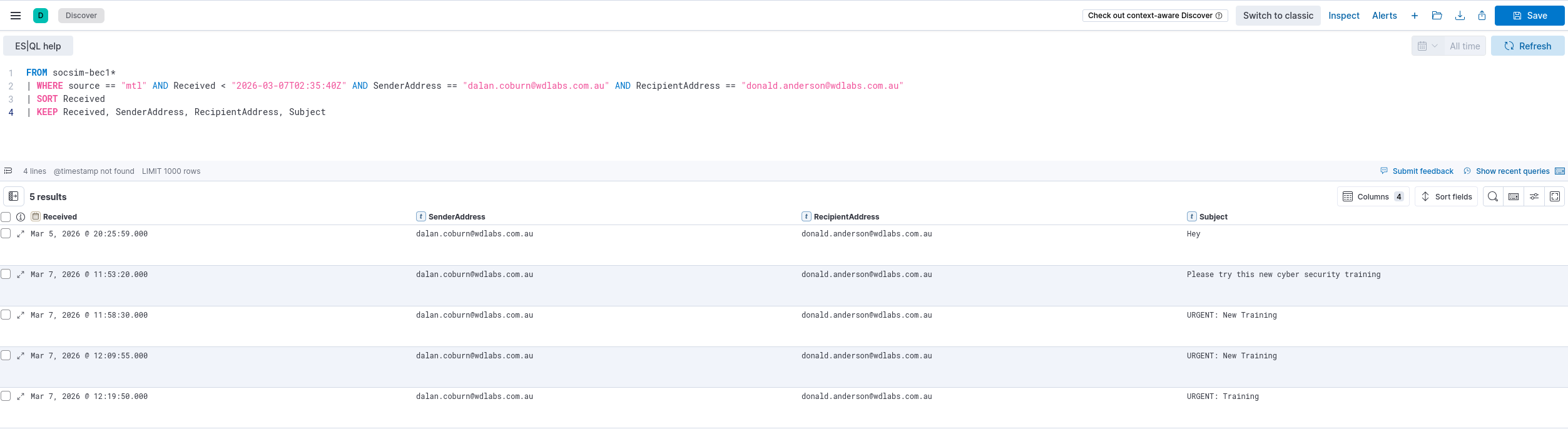 Upon receiving the evidence of Donald Anderson’s mailbox, we are able to locate the contents of the last email in the previous evidence. Based on the contents, we identified a URL that may be used by Dalan Coburn to steal credentials from Donald Anderson.
6.2 Initial Access Evidence
To identify unusual access from the [email protected] account. We executed a query to consolidate client IP addresses and session IDs from the Microsoft 365 Unified Access Logs and grouped them based on the session ID.
FROM socsim-bec1*
| EVAL SourceIp = COALESCE(ClientIP, ClientIPAddress)
| EVAL MasterSessionId = COALESCE(MV_FIRST(DeviceProperties.Value.keyword), AppAccessContext.AADSessionId)
| WHERE source == "ual" AND UserId == "[email protected]" AND MasterSessionId IS NOT NULL
| STATS Count = COUNT(*), FirstAccess = MIN(CreationTime), SourceIps = MV_CONCAT(VALUES(SourceIp), "\n") BY MasterSessionId
| SORT Count DESC
| KEEP FirstAccess, MasterSessionId, SourceIps, Count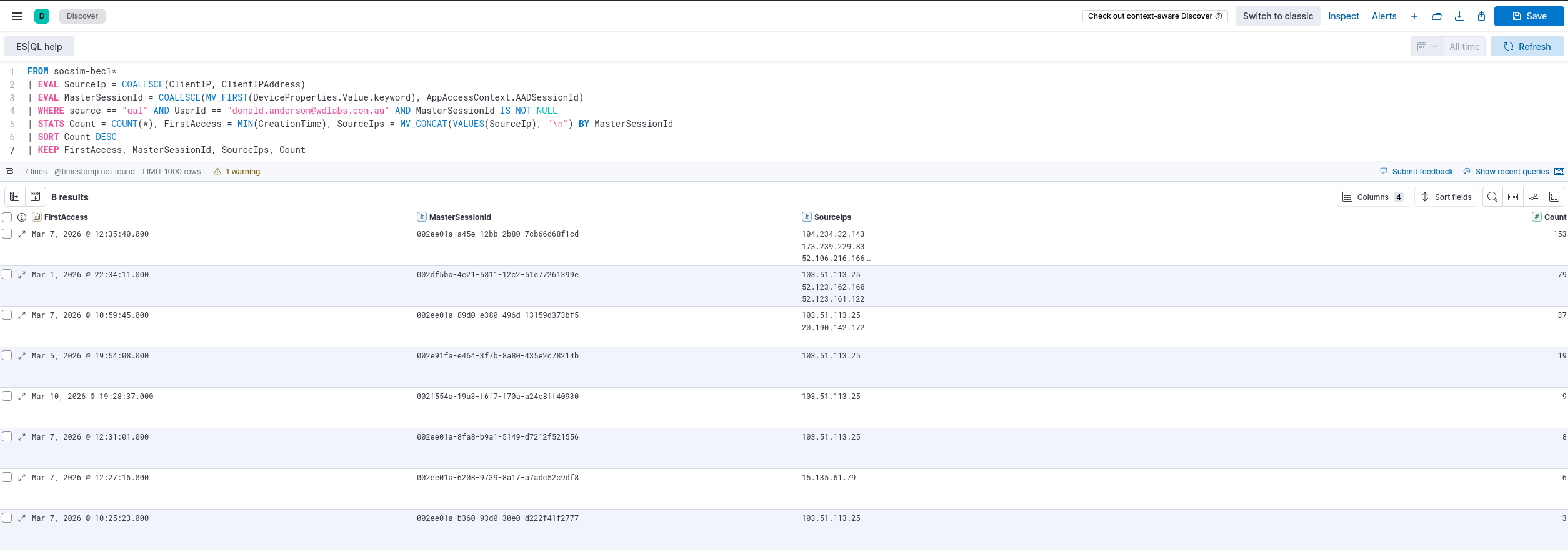 After identifying all IP addresses and session IDs used, we ran all IPs to an API to geo-locate the IP. Results from the API concludes that there are multiple IP addresses that is located outside of Melbourne, Australia.
IP                     Country        City
-------------------------------------------------
52[.]106[.]216[.]166   Australia      Melbourne
103[.]51[.]113[.]25    Australia      Melbourne
52[.]123[.]162[.]160   Australia      Melbourne
20[.]190[.]142[.]172   Australia      Melbourne
45[.]133[.]5[.]165     Australia      Sydney
45[.]133[.]5[.]172     Australia      Sydney
45[.]133[.]5[.]15      Australia      Sydney
45[.]133[.]5[.]24      Australia      Sydney
45[.]133[.]5[.]52      Australia      Sydney
45[.]133[.]5[.]48      Australia      Sydney
54[.]206[.]115[.]107   Australia      Sydney
15[.]135[.]61[.]79     Australia      Sydney
52[.]123[.]161[.]122   Australia      The Rocks
91[.]217[.]249[.]193   Germany        Frankfurt am Main
91[.]217[.]249[.]214   Germany        Frankfurt am Main
91[.]217[.]249[.]210   Germany        Frankfurt am Main
91[.]217[.]249[.]220   Germany        Frankfurt am Main
104[.]234[.]32[.]143   United States  Chicago
181[.]215[.]65[.]116   United States  Chicago
104[.]234[.]32[.]142   United States  Chicago
181[.]215[.]65[.]117   United States  Chicago
104[.]234[.]32[.]115   United States  Chicago
104[.]234[.]32[.]118   United States  Chicago
173[.]239[.]229[.]83   United States  New York
We can also conclude that the 002df5ba-4e21-5811-12c2-51c77261399e session ID is considered the baseline and should be ignored since all IP addresses that uses that session ID are located in Melbourne, Australia. We identified two malicious session ID: 002ee01a-6208-9739-8a17-a7adc52c9df8 and 002ee01a-a45e-12bb-2b80-7cb66d68f1cd.
To identify the initial access timestamp, we crafted a query to get all activities coming from the malicious session IDs and returning the timestamp of the first event.
FROM socsim-bec1*
| EVAL SourceIp = COALESCE(ClientIP, ClientIPAddress)
| EVAL MasterSessionId = COALESCE(MV_FIRST(DeviceProperties.Value.keyword), AppAccessContext.AADSessionId)
| WHERE source == "ual" AND MasterSessionId IN ("002ee01a-a45e-12bb-2b80-7cb66d68f1cd", "002ee01a-6208-9739-8a17-a7adc52c9df8") AND Operation == "UserLoggedIn"
| SORT CreationTime
| LIMIT 1
| KEEP CreationTime, SourceIp, Workload, Operation Upon further inspection using the query below, the
 002ee01a-6208-9739-8a17-a7adc52c9df8 session ID was only used by the threat actor to log in. Therefore, the investigation will focus on the 002ee01a-a45e-12bb-2b80-7cb66d68f1cd session ID.
FROM socsim-bec1*
| EVAL SourceIp = COALESCE(ClientIP, ClientIPAddress)
| EVAL MasterSessionId = COALESCE(MV_FIRST(DeviceProperties.Value.keyword), AppAccessContext.AADSessionId)
| WHERE source == "ual" AND MasterSessionId == "002ee01a-6208-9739-8a17-a7adc52c9df8"
| KEEP CreationTime, SourceIp, Workload, Operation
| SORT CreationTime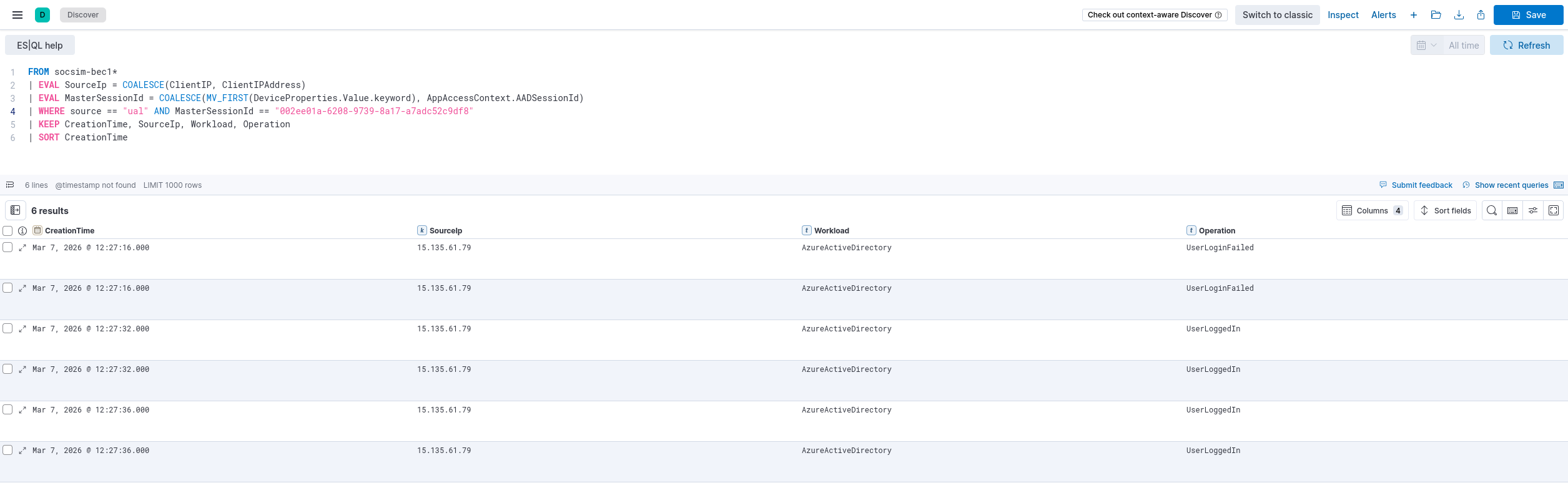
6.3 Email Read Access Evidence
Using the query below, we identified multiple email’s that has been accessed by the threat actor. We suspect that the threat actor is gathering information about the victim and ultimately find their next target.
FROM socsim-bec1*
| WHERE source == "ual"
| EVAL SourceIp = COALESCE(ClientIP, ClientIPAddress)
| EVAL MasterSessionId = COALESCE(MV_FIRST(DeviceProperties.Value.keyword), AppAccessContext.AADSessionId)
| WHERE UserId == "[email protected]"
  AND MasterSessionId == "002ee01a-a45e-12bb-2b80-7cb66d68f1cd"
  AND Workload == "Exchange" AND Folders.FolderItems.Subject IS NOT NULL
| MV_EXPAND Folders.FolderItems.Subject
| STATS CreationTime = MAX(CreationTime),
        Subject = MAX(Folders.FolderItems.Subject),
        Type = MAX(OperationProperties.Value) BY Folders.FolderItems.Subject
| KEEP CreationTime, Subject, Type
| SORT CreationTime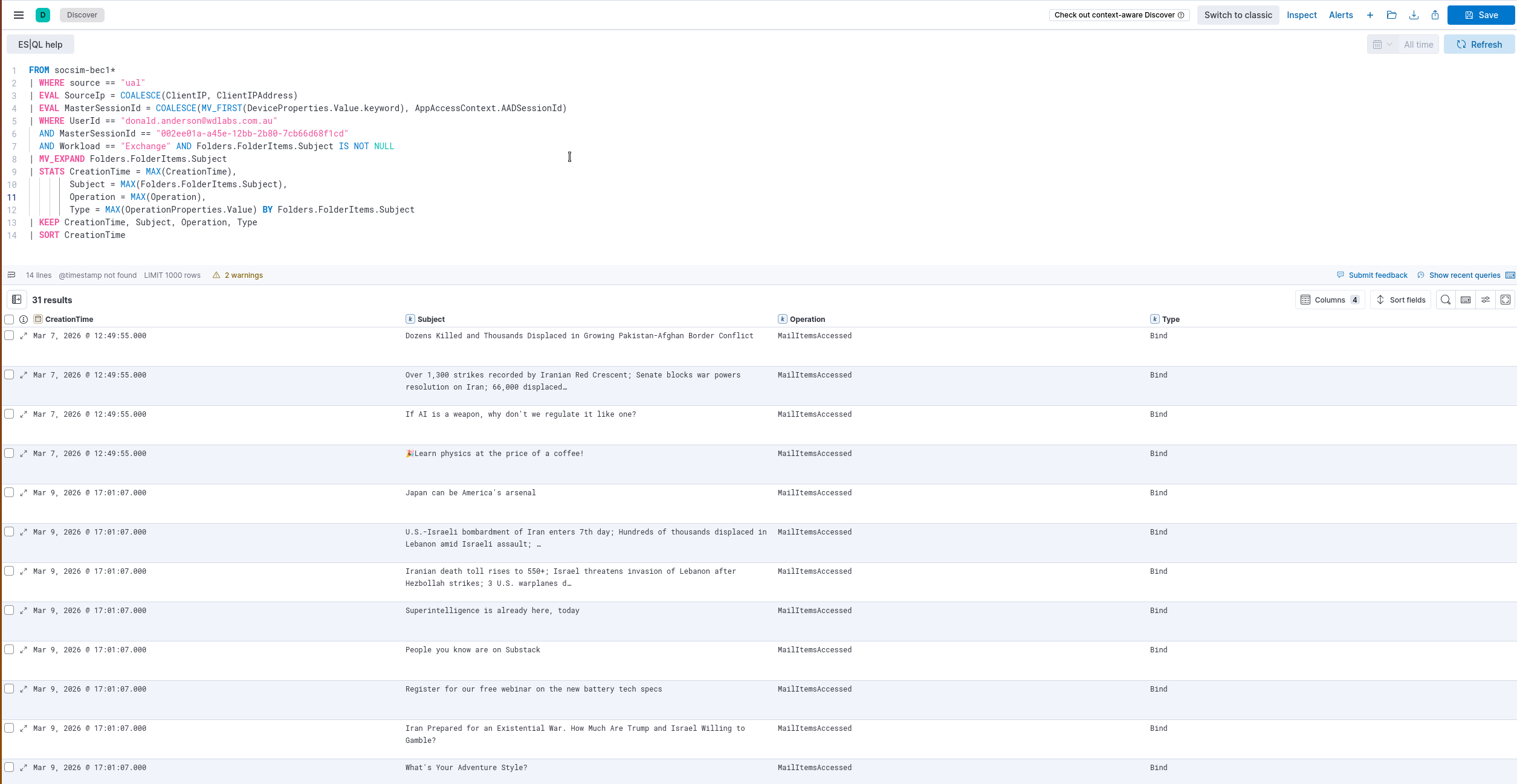
6.4 Malicious Inbox Rule Evidence
To identify the maliciously created inbox rule, we used a query to filter the Unified Access Logs to only return the New-InboxRule operation that is responsible for inbox rule creations.
FROM socsim-bec1*
| EVAL SourceIp = COALESCE(ClientIP, ClientIPAddress)
| EVAL MasterSessionId = COALESCE(MV_FIRST(DeviceProperties.Value.keyword), AppAccessContext.AADSessionId)
| WHERE source == "ual" AND MasterSessionId == "002ee01a-a45e-12bb-2b80-7cb66d68f1cd" AND Operation == "New-InboxRule"
| KEEP CreationTime, UserId, Workload, Operation, Parameters.Name, Parameters.Value Based on the results, we determined that the threat actor created an inbox rule called
 . to mark all emails sent by [email protected] as read and redirects them to RSS Feeds. This tactic is used by the threat actor to hide any alerts or concerned responses sent to the victim.
6.5 SharePoint Exfiltration Evidence
We ran a query to return any FileDownloaded events on SharePoint from the malicious session ID. After execution, we detected multiple exfiltration events of PDF files from the Shared Documents folder of the WDLabsOperation SharePoint site.
FROM socsim-bec1*
| EVAL SourceIp = COALESCE(ClientIP, ClientIPAddress)
| EVAL MasterSessionId = COALESCE(MV_FIRST(DeviceProperties.Value.keyword), AppAccessContext.AADSessionId)
| WHERE source == "ual" AND MasterSessionId == "002ee01a-a45e-12bb-2b80-7cb66d68f1cd" AND Workload == "SharePoint" AND Operation == "FileDownloaded"
| KEEP CreationTime, SourceIp, ObjectId
| SORT CreationTime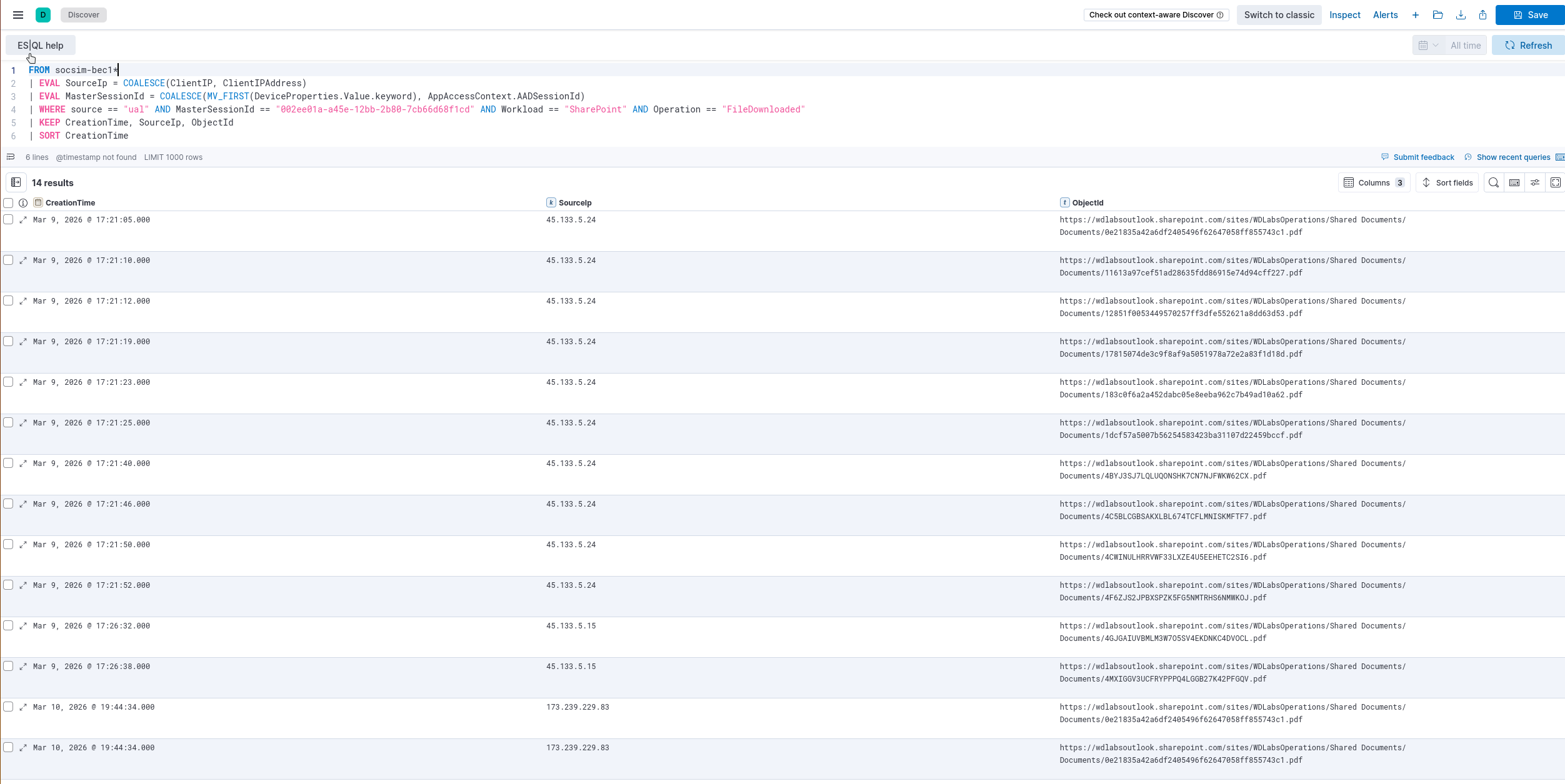
6.6 Suspicious Email Evidence
We crafted a query to return the email sent by Donald Anderson to Naomi Hunter after the identified initial access event. We can identify the subject used by the threat actor is Report.
FROM socsim-bec1*
| WHERE source == "mtl" AND SenderAddress == "[email protected]" AND RecipientAddress == "[email protected]" AND Received > "2026-03-07T12:35:40Z"
| KEEP Received, Subject
| Sort Received From the mailbox evidence, we concluded that the previously mentioned email contains a SharePoint URL. Based on the URL format, we can infer that the URL returns a certain view in the
 Shared Documents/Forms directory of the WDLabsOperations SharePoint site.